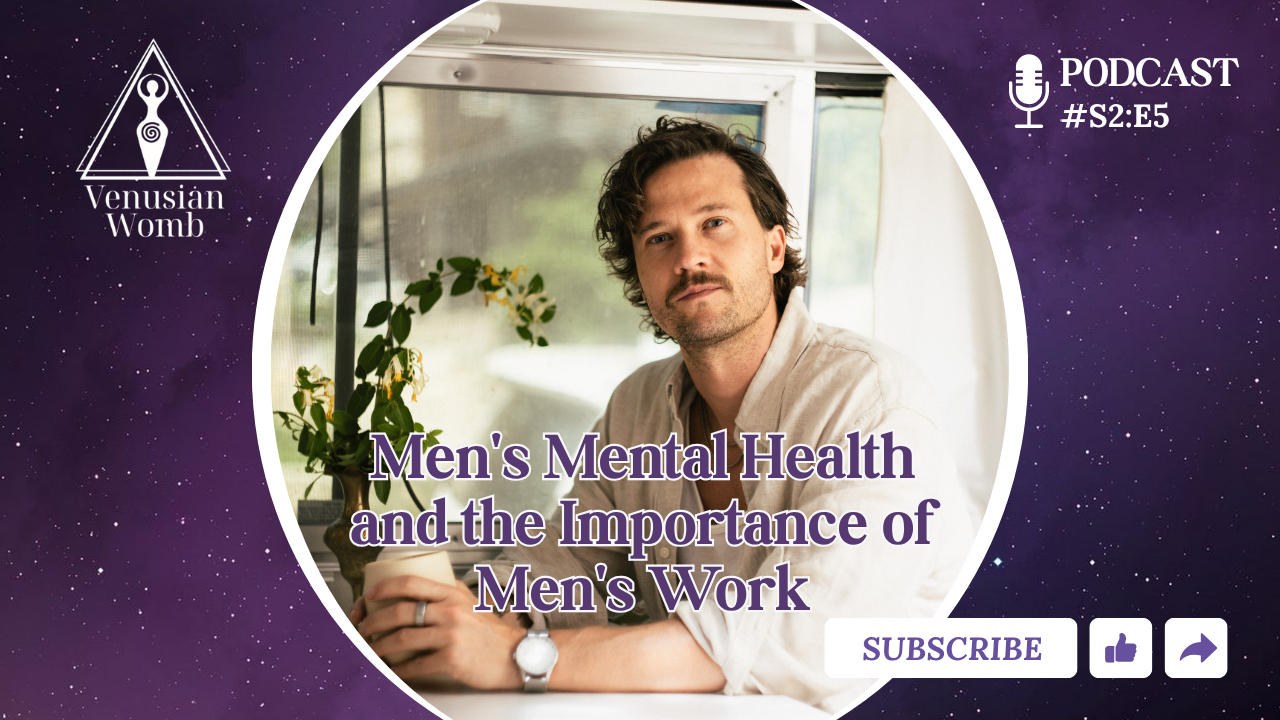
Episode 5: Men's Mental Health and The Importance of Men's Work
This podcast transcript has been produced by Venusian Womb

Episode Summary
What if some of the tension we experience between men and women is not because we care too little, but because we have never been taught how to truly understand one another?
In this episode of the Venusian Womb Podcast, we sit down with men’s mental health and personal growth advocate Mikey Wilson for a conversation about masculinity, femininity, nervous system regulation, emotional expression, and how we can begin relating to one another with more awareness, compassion, and discernment.
Mikey speaks to the reality many men experience in a culture shaped by achievement, productivity, optimization, and constant forward movement. When self-worth becomes tied to external markers such as career, money, status, relationships, or accomplishment, it can become difficult to recognize when striving is coming from genuine desire and when it is being driven by a deeper sense of not being enough.
From here, the conversation opens into an exploration of masculine and feminine energy as qualities that live within all of us, regardless of gender. The masculine can be expressed through action, structure, discipline, direction, and doing, while the feminine invites receptivity, creation, nurturance, presence, and being.
Neither energy is inherently better than the other. The question becomes whether we have access to both.
In a culture that continually rewards doing, achieving, and producing, simply being can feel uncomfortable or even unproductive. We reflect on what it means to notice which energy we are leading with, where imbalance may be showing up, and how that internal relationship can shape the way we relate to others.
The conversation then moves into the body and what nervous system regulation can look like for men. Rather than assuming that everyone regulates in the same way, Mikey speaks to the importance of more embodied pathways into emotional processing, including breathwork, movement, meditation, somatic practices, and physical challenge.
This opens a deeper inquiry into the assumption that talking is always the primary path toward healing. For some men, the doorway into deeper feeling may first come through the body, with language and emotional awareness emerging afterward.
We also explore the importance of brotherhood and spaces where men can be witnessed by other men. Mikey shares his experiences within men’s groups and retreats, describing the value of environments where men can drop the performance, explore anger, grief, fear, vulnerability, and uncertainty, and recognize that they are not alone in what they are carrying.
Rather than placing the entirety of a man’s emotional world inside his romantic relationship, the episode explores the value of men developing meaningful friendships, mentorship, brotherhood, and intentional communities where they can process, challenge one another, and grow together.
The conversation also turns toward relationships between men and women.
What does it mean to support someone without trying to fix them?
What is the difference between holding space and taking responsibility for another person’s emotional world?
And how can women offer nurturing presence without slipping into a mothering dynamic, while men learn to take greater ownership over their own regulation, emotional processing, and support systems?
Together, we explore how presence can sometimes be more powerful than advice, how encouragement can be more supportive than rescuing, and how believing in someone’s capacity does not require carrying their struggles for them.
Ultimately, this conversation is less about defining how men or women should behave and more about becoming curious about the ways we have each been conditioned to relate.
Many of us learned our earliest understanding of masculinity and femininity through our parents, our families, our cultures, and the relationships we witnessed growing up. As adults, we may find ourselves trying to understand one another without ever having been given a shared language for doing so.
At the heart of the episode is an invitation to become more curious about the person in front of you.
Notice what regulation looks like in your own body. Question the places where your worth has become tied to what you achieve. Explore your relationship with doing and being. Build relationships where vulnerability can exist alongside responsibility. And allow the people you love to show you what support actually feels like for them, rather than assuming it will look the same as it does for you.
Because perhaps deeper connection does not come from learning how to make one another more alike.
Perhaps it begins when we become willing to understand our differences without immediately trying to change them.
Key Takeaways
Calls to Reflection and Action:
- Notice where you may be living in constant “doing” mode. Reflect on how much of your energy is going toward achievement, productivity, and external validation, and explore what helps you return to a more regulated, grounded state. The episode invites listeners to become more aware of the balance between masculine “doing” energy and feminine “being” energy in their own lives.
- Learn what regulation actually looks like for you, rather than assuming one approach works for everyone. Experiment with practices that help you come back into your body, whether that is breathwork, movement, meditation, somatic work, or simply recognizing when you are dysregulated. The conversation especially highlights that men may benefit from more physical, embodied ways of processing emotion rather than relying only on talking.
- Rethink how you support the men and women in your life.
Instead of trying to fix, manage, or regulate someone else, consider what it means to offer presence, respect, encouragement, and space for them to take responsibility for their own inner world. The episode also invites men to cultivate meaningful brotherhood and supportive spaces beyond their romantic relationships.
Episode Links
This episode of The Venusian Womb Podcast is available on Spotify, Apple Podcasts, and wherever you get your podcasts.
Share this episode